We sell lanterns, sconces and candelabra, and every one of them says LED only. That is a real constraint and it is worth explaining rather than burying in a care note — along with what you genuinely give up by not using a flame.
What a real candle does better
Three things, and they are not small.
The light. A flame flickers because it is an unstable combustion process, and the variation is irregular in a way electronics approximate rather than reproduce. Good LED tealights get close; nothing gets it exactly.
The colour. A candle flame sits around 1800K — considerably warmer than the warmest LED bulb you can buy, which is why candlelight flatters a room in a way nothing else does.
The smell, and the occasion. Lighting a candle is an action. It marks the start of an evening. Flipping a switch on the bottom of a plastic puck does not, and pretending otherwise is silly.
What an LED does better
It cannot burn your house down. This is the entire argument and it is a strong one. Candle fires in Canada peak in December, and the usual causes are unattended candles, candles near something combustible, and candles reached by a pet or a child. An LED removes the whole category.
It works where a flame cannot. A bookshelf, a sleeping bedroom, a room with a cat, a rental that forbids open flame, a dinner table with children at it.
No soot. Burning paraffin deposits carbon on walls and ceilings — the grey ghosting above a spot where someone burned candles for a winter is real and very hard to wash off.
Cost. A rechargeable LED tealight runs for years. Real tealights at a few hours each, burned regularly, add up quietly.
It does not go out or drip. A draught kills a flame; a lantern with a pierced design is full of draughts by definition.
Why printed holders are LED-only
Not caution — physics. Printed plastics soften at temperatures a candle flame passes easily, and a lantern’s whole job is to sit close to the light source. A tealight flame in an enclosed printed lantern will deform it, and the deformation starts well before anything visible happens.
It is also why thin-walled pieces work so well with LEDs. Our tealight flame is thin enough that light passes through the whole sculpted form and carries the flicker up its full height. That thinness is only possible because there is no heat.
Buying LED tealights that are actually good
Most of them are bad. The ones worth having share a few things:
- Amber, not white. A cool-white LED behind a flame-shaped diffuser looks like an appliance. Amber is the only colour that reads as fire.
- Irregular flicker. Cheap units pulse on a short, obvious loop. Better ones use a randomised pattern you stop noticing.
- Rechargeable, if you will use them often. A set on an induction charging tray is markedly less annoying than a drawer of CR2032 batteries.
- A remote or a timer if they are going anywhere awkward — inside a lantern with a lid, high on a shelf, in a sconce.
Matching the light to the holder
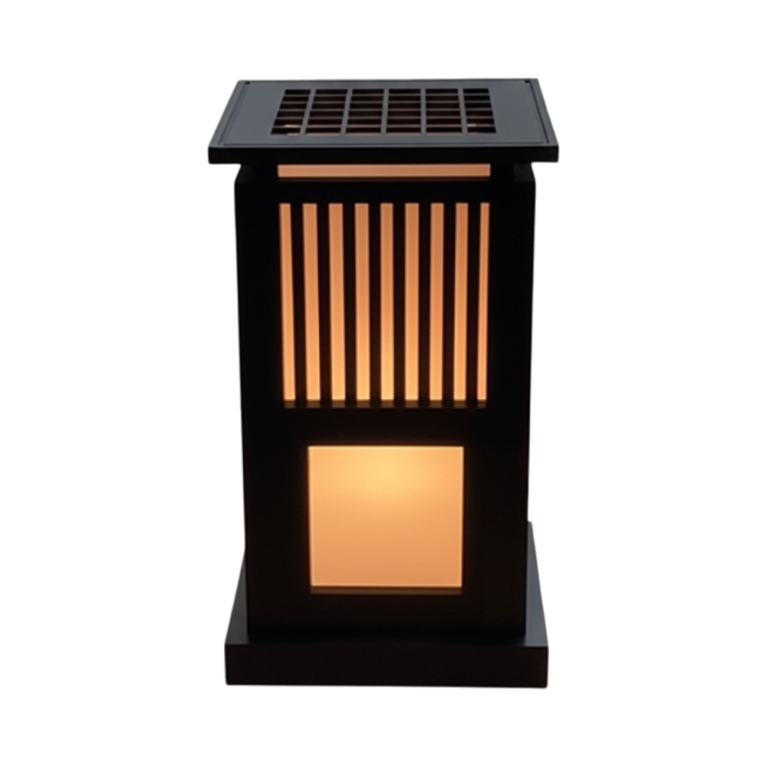
Pierced and slatted designs want a bright, point-like source, because the effect is the shadow pattern thrown outward. Our gothic lantern and slatted lantern both work this way.
Thin-walled and sculpted designs want a diffuse source, because the effect is the glow through the material itself — the lithophane lantern and the tealight flame are in this group.
Multi-arm pieces like the five-candle candelabra take LED tapers rather than tealights, and a set with a synchronised flicker looks considerably better than five independently flickering ones.
The honest conclusion
If you want the smell and the ritual, burn a real candle — in a ceramic or glass holder, on a hard surface, away from anything, and never out of the room. That is a genuinely different experience and we are not going to pretend otherwise.
For everything else — a lantern that runs all evening, a sconce on a wall, a table set with five lights, a bedroom, a house with a cat — LEDs win on every axis except romance, and the holders we make are built for them.
The lighting and candles range is printed to order in Canada.