Nearly every rented flat and most houses are lit the same way: one fixture, in the centre of the ceiling, pointing down. It is the cheapest possible way to make a room visible and close to the worst way to make it feel like anything.
Why the overhead light is the problem
Light from directly above casts shadows straight down. Under faces that means dark eye sockets; across a room it means every surface lit to the same flat brightness with no variation anywhere. Nothing has depth, because depth in a room is created by the difference between lit and unlit.
It is also usually a single colour temperature, usually too cool, and usually either fully on or fully off. That is a light for finding your keys, not for spending an evening in.
The fix: three lights, three heights
The standard advice in lighting design is at least three sources at different heights in any room you actually sit in. Not three times the brightness — three positions. Something low, something at eye level when seated, something higher.
Low is a floor lamp, a lamp on the floor behind a plant, or a candle-height source on a low table. It throws light upward and sideways, which is the opposite of what the ceiling does, and it fills the shadows the overhead created.
Seated eye level is a table lamp on a side table or sideboard. This is the one that does the most work, because it is the light you actually see rather than the light you see by. A shade with texture — like our modern lamp, which throws a ribbed pattern onto the wall behind it — gives you a lit object as well as illumination.
Higher is a wall sconce, a shelf lamp, or a tall floor lamp aimed at the ceiling to bounce light back down softly. Bouncing is the trick: light reflected off a white ceiling is diffuse and flattering in a way a direct bulb never is.
Colour temperature, and why your room feels like an office
Bulbs are sold by Kelvin. 2700K is warm — the colour of an old incandescent, and the right number for a living room or bedroom. 3000K is slightly crisper and fine for a kitchen. 4000K and above is the light of a hardware store, and it is what a great many rental fixtures come fitted with.
Changing every bulb in a room to 2700K costs about twenty dollars and changes the room more than new cushions would. If you do one thing from this article, do that one.
And keep it consistent. Two lamps at 2700K and one at 4000K reads as a mistake even to people who could not tell you why.
Layers that are not lamps
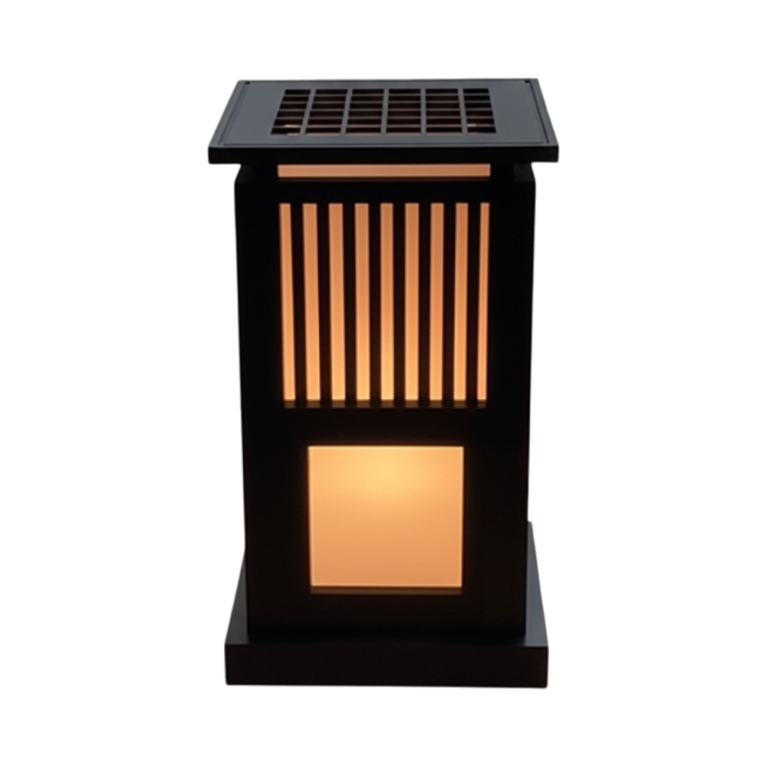
A lantern with an LED tealight in it is a light source, and at table height it does real work. Our slatted lantern throws banded light onto the surface it stands on, and the gothic lantern projects pierced arch shadows up the nearest wall. Three of either down a dining table replaces a centrepiece and lights the table properly.
A lithophane lantern goes further: the panels look plain until lit, then resolve into an image. That is a light and a thing to look at in one object.
Wall sconces are the underused category. A stag sconce or ram sconce with an LED candle on its shelf puts light at a height nothing else in the room occupies, and needs one fixing.
If you rent and cannot change the fixture
You do not need to. Everything above plugs in. The one thing worth doing to the existing fixture is putting a warm bulb in it and then, mostly, leaving it off — treat it as the light you use when you are looking for something, not the light you live under.
Smart plugs are the other cheap win. Three lamps on three plugs, on one schedule, means the room lights itself at dusk without you crossing it turning knobs. That is what makes a multi-lamp setup survive contact with real life; otherwise you will use the ceiling light because it is by the door.
Safety, briefly
Printed shades and lanterns are designed around LEDs, which run cool. Never fit an incandescent or halogen bulb in one, and never put a real flame in a printed lantern — LED tealights give the same flicker with none of the heat. Everything in our lighting range is built on that assumption.
In order, if you are doing it gradually
- Change every bulb in the room to 2700K.
- Add one table lamp at seated eye level.
- Add one low source — floor lamp, or lanterns on a low table.
- Add one high source — a sconce, or a lamp bounced off the ceiling.
- Put them on a schedule so you actually use them.
Step one costs twenty dollars and does about a third of the work.