Everyday carry is the small set of objects you have on you every day: keys, wallet, phone, a knife or multitool, a light, a watch, maybe a pen. The term came out of the outdoor and tool communities and has spread, and the reason it stuck is that it names something real — these things are a set, and they move together.
The problem a dish does not solve
Empty your pockets into a bowl and you get a pile. The watch ends up under the keys, the knife ends up under the wallet, and in the morning you are sorting through it with one hand while doing something else.
A pile also scratches. A watch crystal against a set of keys for eight hours a night, every night, is exactly how a watch gets a scratched face — not from wearing it.
What a proper tray does differently
It has a defined place for each thing, sized for that thing.
- A long channel for a knife, a pen or a torch, so it lies flat rather than rolling.
- A flat bay for a wallet or a phone, wide enough that it does not have to go in at an angle.
- A shallow dish with a soft radius for a watch, so the face sits on a curve rather than an edge.
- A deeper well for keys and coins, which are the things that roll and rattle.
Our EDC organiser tray is laid out this way, and the EDC adventure tray does the same thing with a topographic contour floor — the contours are decorative and also functional, because they stop small items sliding into one corner.
It takes about two days to stop thinking about where things go. After that the tray is invisible and the mornings are quieter.
Where to put it, which decides everything
Not where it looks best. Where you already empty your pockets.
If that is the kitchen counter, the tray goes on the kitchen counter, however much you would prefer it on the nightstand. A valet tray in the wrong room is an ornament. This is the single variable that decides whether it gets used, and people get it wrong constantly because they buy it for the bedroom and live in the hallway.
If you genuinely empty your pockets in two places, buy two. They are not expensive, and the alternative is that one of the two locations keeps generating piles.
Depth and the knock test
A tray with a shallow lip lets everything out when it gets knocked, and it will get knocked — by a sleeve, by a cat, by you reaching past it in the dark.
The lip needs to be high enough to contain a rolling coin. That is a lower bar than it sounds, but a surprising number of decorative trays fail it, because a high lip looks heavier and designers keep shaving it.
The base
A tray that slides is worse than no tray, because you will push it across the dresser every time you drop keys in it and eventually off the back. Weight, a non-slip base, or both.
This also matters for the surface underneath — a hard printed base dragged across a lacquered dresser will mark it over a year. A soft base or a felt pad underneath is a five-minute fix.
What goes in it, and what does not
Only things that leave the house with you. The moment it starts holding a battery, a receipt and a screwdriver, it stops being an EDC tray and becomes a dish again — and the keys go back to being lost.
A small tray enforces this better than a large one. Capacity invites accumulation. If everything does not fit, something in there is not everyday carry.
For a desk rather than a bedside
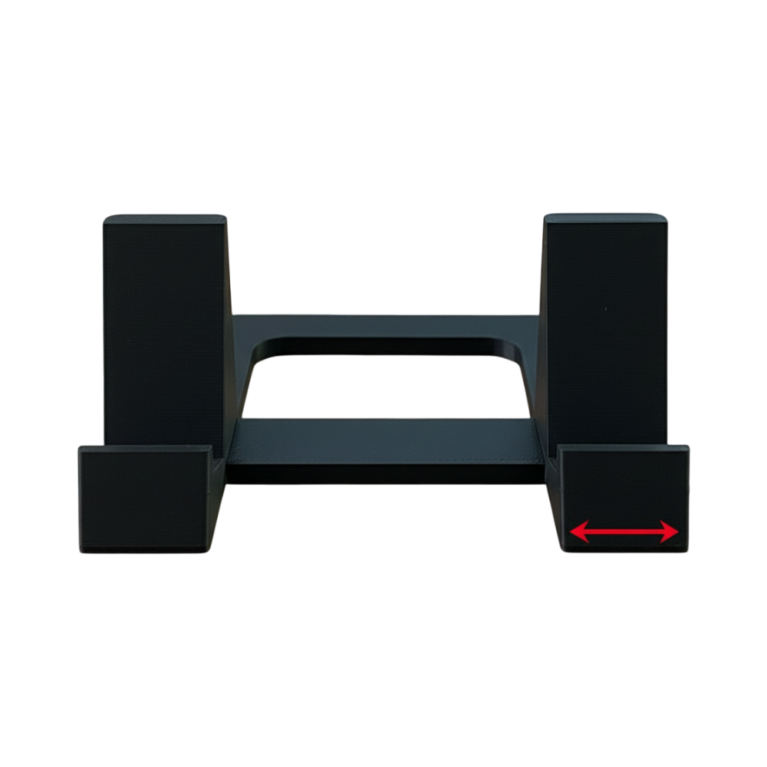
The desk version of the same idea has different contents: pens, a notebook, drives, clips, cables. A desktop storage rack with compartments sized for those specifically — a tall bay for pens standing up, a wide shallow one for a notebook, a slot for a phone on edge — does the same job in an environment where the objects are different shapes.
The principle is identical: a defined size per item beats a row of identical square holes.
A small aesthetic point
A single matte colour shows relief and contour far better than two tones or a gloss finish. If the tray has a textured or topographic floor, that texture is the design — a busy colour scheme fights it, and gloss flattens it into a highlight.
The storage and organisation range is printed to order in Canada, so a tray sized to a specific nightstand or a particular watch is a request rather than a compromise.