A wall planter solves a real problem: floor space. In a small flat the horizontal surfaces are already spoken for, and the walls are empty. But a pot on a wall is a pot you cannot casually pick up, and a wall is harder to undo than a shelf. Five minutes of checking saves a lot.
Find out what your wall actually is
In most Canadian homes the interior walls are drywall over wood studs at 16 inches on centre. A screw into drywall alone holds almost nothing once there is weight and leverage involved — and a planter full of wet soil has both.
Three options, in order of preference. Into a stud, with a wood screw: strongest by a wide margin, and free. Into drywall with a proper toggle or self-drilling anchor rated for the load: fine for most planters, and the rating on the packet is per anchor, so two anchors is two ratings. Into drywall with the little plastic plugs that came in the box: no.
If the wall is concrete, brick or plaster over lath, you need a masonry bit and the matching plug, and the job is slower but the result is stronger than drywall will ever be. Older Canadian homes with plaster-and-lath are the awkward case — the plaster is brittle, so drill slowly and do not over-tighten.
Work out the real weight
People weigh the pot. Weigh the pot, plus the soil, plus the water the soil holds when you have just watered it, which is roughly its own volume again in the first hour. A small planter that weighs 400g empty can be pushing 1.5kg immediately after watering.
Then add leverage. A planter that projects six inches from the wall is not pulling straight down on the fixing, it is trying to lever the top of the fixing out of the wall. That is why a planter which feels trivially light in your hand can pull a plug out of drywall three weeks later.
Designs that spread the load across two fixing points — like our low-poly wall planter — are meaningfully better than a single central screw for exactly this reason.
Decide how you will water it before you hang it
This is the part everybody skips. A planter on a wall is above something: a floor, a sofa, a bed, a bookshelf. Anything that runs out of the bottom lands on that.
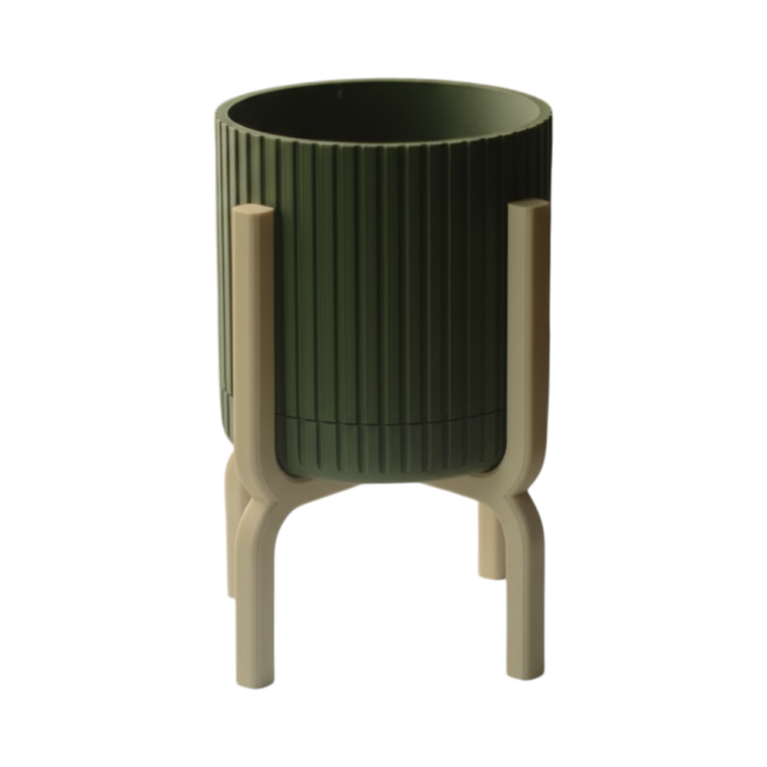
Two workable approaches. Either use a sealed planter with no drainage hole and take it down to water it over a sink — which means the mount has to be a hook-and-plate rather than something screwed through — or use a slow-drip reservoir design where you add a measured amount to a chamber rather than pouring onto soil. Our HexaRain slow-drip planter takes the second approach and works either on a wall or standing on a table.
What does not work is a drainage hole over a carpet and a promise to be careful.
Light at wall height is different from light at table height
Walls are usually further from the window than the surfaces below them, and often perpendicular to it rather than facing it. A spot that looks bright to you because the room is bright may be getting a fraction of what a windowsill gets.
Trailing plants are the pragmatic answer — pothos, string of hearts, ivy — because they tolerate less light and because they look better falling from a height than sitting on a table. Anything that needs real sun should be at the window, not on the wall beside it.
Renting?
You still have options. A single small anchor hole is a two-minute repair with filler and a dab of paint at move-out, and most leases are concerned with damage rather than pinholes — though it is worth reading yours rather than taking our word for it. Adhesive strips rated well above the wet weight can work for the lightest planters on a smooth painted wall, but they fail in humidity, which is the whole environment a plant creates.
The lowest-risk route in a rental is a grid or a shelf with a small number of fixings that carries several pots, rather than several planters each with their own hole. Our modular plant grid is designed around that: one mounted structure, pots that clip in and move.
The short version
- Find the stud. If you cannot, use an anchor rated well above the wet weight, and use two.
- Weigh it wet, and remember that projection multiplies the load on the fixing.
- Decide how it gets watered before it goes up, not after.
- Trailing plants for wall height; sun-lovers stay at the window.
- In a rental, one mounted structure with several pots beats several holes.
The wall decor range and the planters are all printed to order in Canada, so if you need a particular size or a colour matched to your wall, that is a conversation rather than a no.