Most vase advice treats every vase as the same object. It is not. A vessel for dried pampas and a vessel for a bunch of tulips have almost nothing in common, and buying the wrong one is how people end up with a beautiful vase that holds flowers badly.
The fresh-flower requirements
It has to be watertight, properly. Not “does not obviously leak” — watertight over days, with water sitting against the interior. A printed vase is watertight when it has been sealed internally; ask before you order, and we will seal it before it ships. Unsealed, it is a dried-stem vessel, and that is an honest distinction rather than a limitation.
The neck has to do work. Fresh stems are heavy, wet and slippery. A wide mouth lets them collapse outward until the whole arrangement lies flat against the rim. A neck that narrows and then flares — our Venere vase is drawn on exactly that hourglass — gathers the stems at the waist and then lets the heads fan. That is the shape doing the arranging for you.
You need to be able to get your hand in. A vase you cannot reach into is a vase you cannot clean, and a fresh-flower vase gets slimy within a week. If the opening is narrower than your fist, you are committing to a bottle brush.
The dried-stem requirements
None of the above. Dried stems weigh almost nothing, do not rot, and do not need water. What they need instead is height and base weight.
Pampas grass, eucalyptus and bare branches are long, and their mass is at the top. A tall vase with a light base is a lever waiting to happen. Our large vase is built with weight low down for that reason; the same logic applies to any tall vessel.
Dried arrangements also stay put for months rather than days, which changes what matters. The vase is furniture now, not a container. It should look right empty, because for part of the year it will be.
The disc vase case
A flat, disc-shaped vase — a circle standing on its edge, two inches deep — is a specific solution to a specific problem: a narrow shelf or console where a round vase overhangs the edge. From the front it has full presence; from the side it almost disappears. Our Bohemian circle vase is this shape, and it holds three or four stems upright without any help, which round wide-mouth vases cannot.
It is a bad choice for a big bouquet and an excellent one for three stems on a hall table.
Empty is the default state
This is the part people underrate. A vase spends most of its life with nothing in it. A shape that only works when full is a shape that fails eleven months of the year.
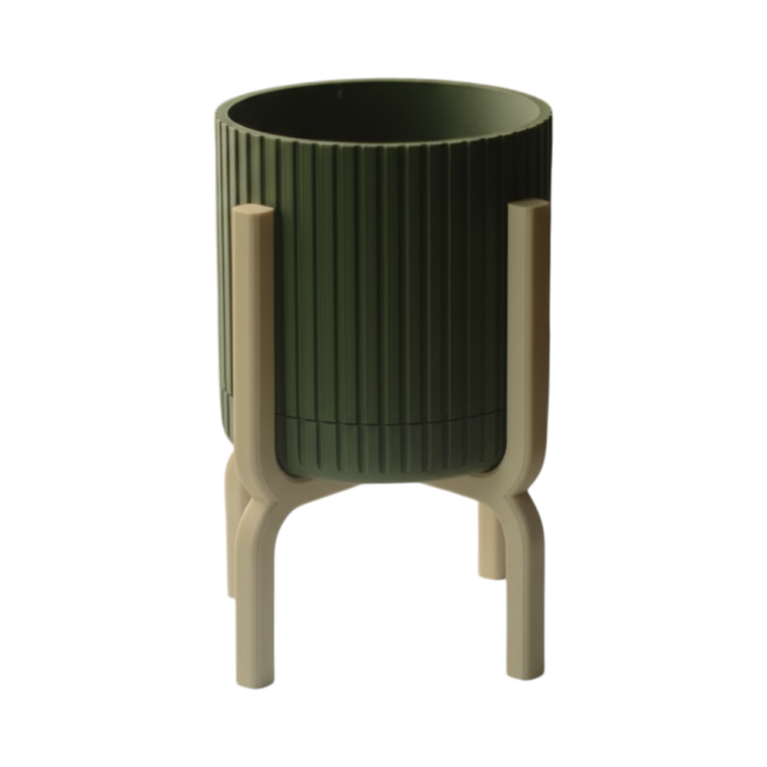
The vases that survive that test are the ones with a resolved silhouette — a single unbroken profile, or a deliberate texture that catches light. Our Scandinavian vase is an extreme version of this: no ornament at all, and proportions chosen so it reads as a considered object standing alone. Restraint of that kind is harder to design than decoration.
Practical notes
- Cloudy water is bacteria. Change it every two days, recut the stems at an angle, and strip any leaf that sits below the waterline — submerged foliage is what rots first.
- Do not put a printed vase in a dishwasher. The heat cycle will distort it. Warm water, mild detergent, by hand.
- A frog or a grid — anything that subdivides the opening — turns a too-wide vase into a usable one. Cheaper than buying another vase.
- Dried stems fade in direct sun, particularly dyed pampas. Out of the sunbeam, they last years.
Choosing, in one line each
Fresh flowers, regularly: sealed, hourglass neck, hand fits inside. Dried stems, semi-permanently: tall, weighted base, looks good empty. A narrow shelf: a disc. A room that already has a lot going on: something plain.
The full vase range is printed to order in Canada, and sealing for fresh flowers is a request rather than a separate product — just tell us when you order.