Ask a designer what changes when you move from injection moulding to additive manufacturing and you will usually get an answer about prototyping speed. That is true, and it is the least interesting part. The bigger change is that a whole category of shapes stops being impossible.
The rule that shapes everything you own
Injection moulding works by forcing molten polymer into a steel cavity and then opening the cavity. That last step — the part has to come out — is the constraint that quietly determines how almost every mass-produced object looks.
It is why moulded parts have draft angles, so they release. It is why wall thicknesses are uniform, so they cool evenly and do not sink. It is why there are no undercuts unless the tool has expensive sliding cores. It is why nearly everything is a shell with ribs, rather than a solid with intelligent internal structure. None of those are aesthetic decisions. They are the mould talking.
What additive removes
Printing builds a part one layer at a time, with no tool to release from. That single difference unlocks four things.
1. Internal structure
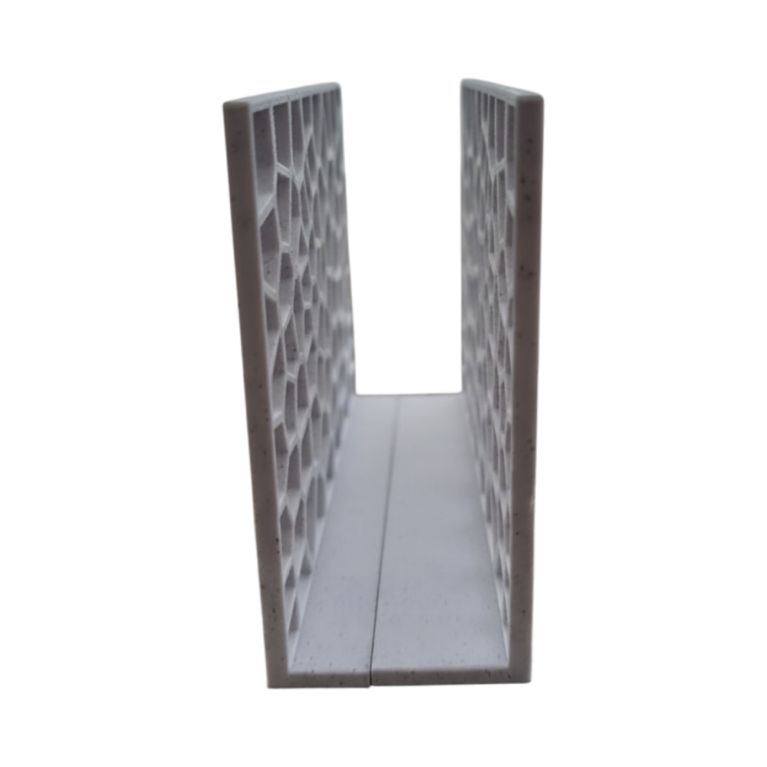
A printed part does not have to be either solid or hollow. It can be a controlled lattice — dense where loads concentrate, sparse everywhere else. You get stiffness where it is needed and lightness everywhere else, in one part, with no assembly. A moulded part cannot have an internal lattice at all, because there is no way to get the mould back out of it.
2. Compound curves and continuous surfaces
Shapes that twist, taper and fold back on themselves are routine when you build in layers. That is why printed vessels and sculptural pieces read the way they do — not as decoration applied to a cylinder, but as geometry that could not have been turned, cast or moulded.
3. Moving parts printed in place
Hinges, chains, joints and living mechanisms can be printed already assembled, with the clearance built in. Nothing is put together afterwards and nothing can be lost. Every articulated fidget and articulated piece we make comes off the plate working.
4. Consolidation
Where a moulded design would be six parts and four fasteners — because each part has to be mouldable on its own — a printed design is often one part. Fewer parts means fewer failure points, no assembly labour and nothing to rattle loose.
What additive adds back
Additive has its own rules, and pretending otherwise produces bad products.
Anisotropy. A printed part is stronger across the layers than between them. A design has to place the load along the strong direction, which means orientation on the build plate is a design decision, not a production detail.
Overhangs. Steep unsupported overhangs need support material, which costs time and leaves marks. A well-designed printed part is drawn so that its critical surfaces do not need support at all.
Surface finish. Layer lines exist. They can be minimised, oriented so they read as texture, or embraced as part of the surface, but a design that assumes a glass-smooth moulded finish will disappoint.
Heat performance. Common printing polymers soften at lower temperatures than many moulded ones. If a piece will live somewhere hot, that is a material decision made at design time — see our guide to printing materials.
How this works in practice at Compl3x
A design goes from a sketch to a printed object in hours, not months. It gets used — actually used, in a kitchen or on a desk — and then it gets criticised. The wall that flexed gets thicker. The lip that was awkward gets a radius. The part that needed support gets rotated forty degrees so it does not.
Because there is no tooling to amortise, none of those changes cost anything but time. A product can be on its fifteenth revision by the time it is listed, and it can quietly move to its sixteenth next month. No mass-production pipeline can do that, which is exactly the point of building this way.
If you want a piece designed around a constraint nobody else has solved, that is what our custom manufacturing services are for. Or start with the catalogue and see what the process produces.