A 3D printed product is not fragile, but it is not indestructible either, and the things that shorten its life are not the ones most people expect. It is almost never dropping it. It is heat, sunlight and the dishwasher.
Here is what actually matters, in the order it matters.
1. Keep it out of sustained heat
This is the single biggest cause of a printed piece deforming. The common printing polymers soften well below the temperature of boiling water, and a shape that softens under its own weight does not come back.
The three environments that catch people out:
- A car in summer. A closed cabin in direct sun reaches temperatures that will slump a PLA part in an afternoon. If you want something for a vehicle, it needs to be made in a higher-temperature material — tell us before you order.
- A dishwasher. Hot wash plus hot dry is the fastest way to ruin a printed piece. There is no printed product we make that belongs in one.
- A windowsill or a radiator shelf. Ambient heat plus direct sun compounds. Move it a foot and the problem disappears.
2. Limit direct sunlight
UV breaks down most polymers over months rather than days. The symptoms are colour fading, a chalky surface and eventual brittleness. Indoors, away from a south-facing window, this effectively never becomes an issue. On a balcony or in a conservatory it will, unless the piece was specifically made in a UV-stable material like ASA.
If you want a piece for an outdoor spot, say so when you order. It is usually a straightforward change on our end and it triples the working life of the object.
3. Clean it properly, which is to say gently
Warm — not hot — water, a drop of dish soap, a soft cloth. That is the whole method.
What to avoid:
- Solvents. Acetone, alcohol-based cleaners and anything labelled as a degreaser will attack the surface of some polymers and craze others.
- Abrasive pads and scouring powder. They will dull a surface that was smooth, permanently.
- Bleach. It discolours pigments.
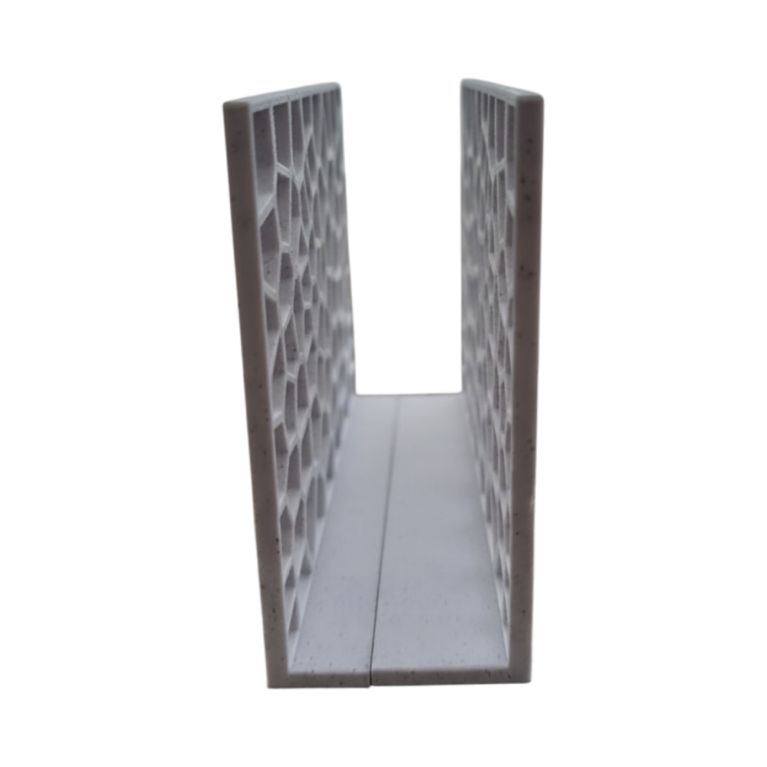
For a textured or patterned piece — a lattice vase, a detailed sculpture — a soft dry brush gets dust out of the recesses far better than a cloth does.
4. Use it for what it was designed for
A printed household piece is engineered for household loads. A shelf or holder from our catalogue is designed around the weight of the things it is meant to hold, with a sensible margin. It is not a structural component and it is not a step stool.
If you need something to carry a genuinely heavy or safety-critical load, that is a different design conversation and a different material — ask us rather than hoping.
5. Water, food and printed surfaces
Two honest points that get glossed over elsewhere.
Printed vessels are not guaranteed watertight. The layer structure that makes printing possible is also a potential path for moisture. For a vase, the answer is simple: drop a glass or plastic tube inside for the water. It also makes cleaning far easier.
Printed surfaces are not certified for direct food contact. Microscopic layer lines are difficult to sanitise completely. Use a liner, a plate or the original packaging for anything edible. This is true of printed products generally, not just ours.
6. Small repairs are usually possible
Because the design still exists as a live file rather than a retired mould, a broken component can often simply be reprinted — one shelf bracket, one lid, one clip, rather than the whole assembly. If something fails, contact the studio before you throw it out. That is one of the quieter advantages of made-to-order production, and it is worth using.
The short version
Keep it out of hot cars and dishwashers, keep it out of long direct sun unless it was made for it, wash it by hand with mild soap, and use it for the job it was designed to do. Do that and a printed piece will comfortably outlast the moulded equivalent — and when something does eventually break, we can make the part again.